TAWTHIQ — Tamper-Evident Provenance Chain for Human Decisions over AI
In one paragraph
A local-first provenance chain that makes AI-assisted decisions forensically verifiable: records are SHA-256 hashed and chain-linked, signed with the owner's hardware-bound key, and time-stamped via OpenTimestamps (Bitcoin). An offline, dependency-free verifier lets any auditor re-check who approved what, and when — without our code and without trusting us.
Scientific poster (PDF) Verification bundle (ZIP, 1.1 MB)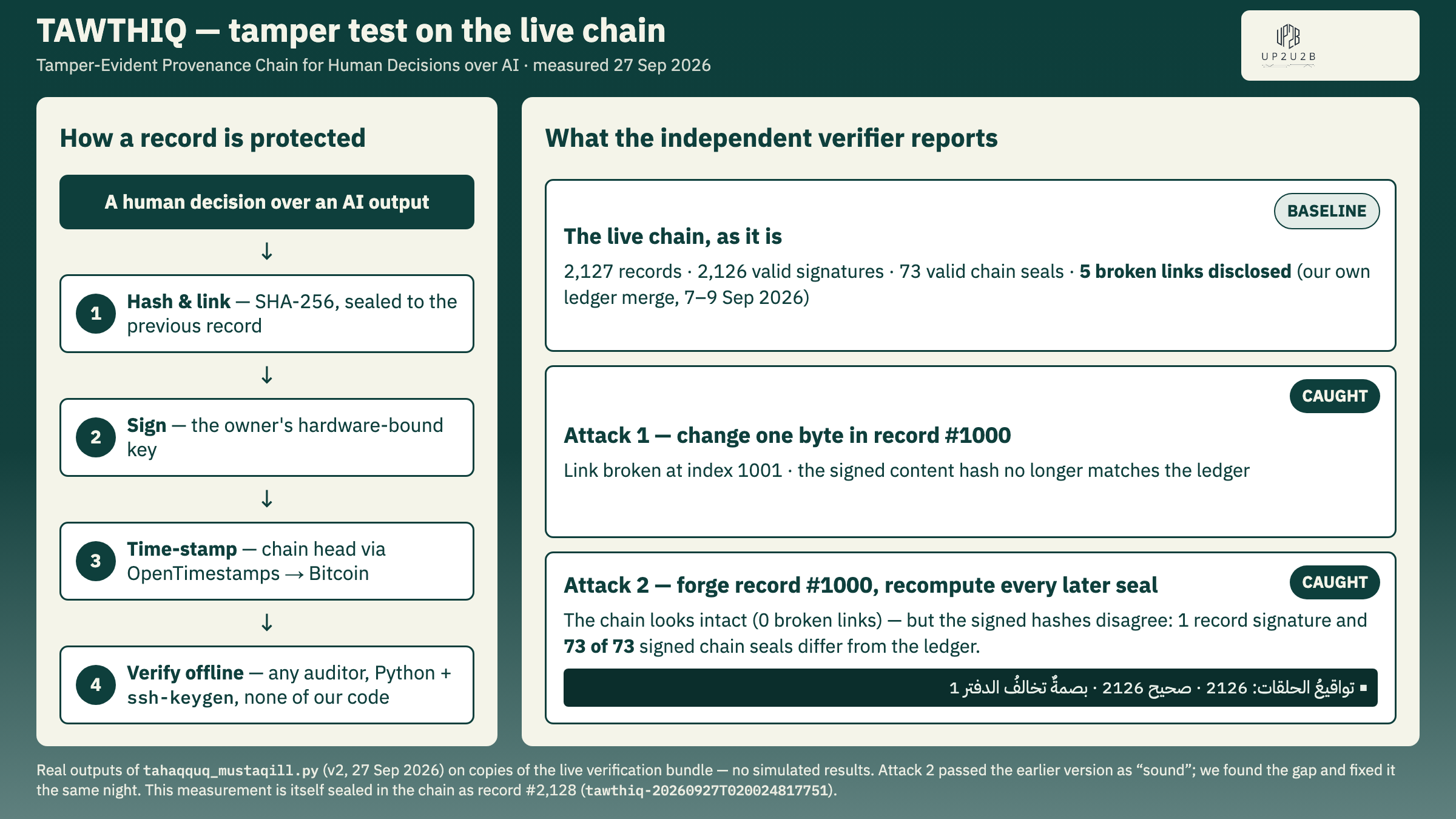
Measured results — 27 Sep 2026
Measured by the independent verifier on the live chain at head 3efabf9c… — and then sealed in the chain itself as record #2,128 (tawthiq-20260927T020024817751), signed with the owner's hardware-bound key. The measurement is evidence inside the ledger, not a number on a screen.
| 2,127 | records sealed since 4 June 2026 |
| 2,126 | record signatures, all valid (2,097 with the hardware-bound key; 29 with a software key) |
| 73 | chain seals, all valid (latest 19 Sep 2026; 51 later records await the next seal) |
| 32 | OpenTimestamps stamps recorded (2 confirmed in Bitcoin block 965242, checked 4 Sep 2026) |
| 5 | broken links, detected and named by the verifier — caused by our own ledger merge (records of 7–9 Sep 2026). Disclosed, not rewritten. |
Limits. Single writer, not distributed. Key residency in hardware is asserted by the setup and cannot be proven from the public key alone. Full confirmation of the time stamps requires a Bitcoin node or an independent block explorer.
Tamper tests — 27 Sep 2026
Run on copies of the live bundle with the verifier included here (v2):
| Baseline | Live chain as it is: 2,127 records · 2,126 valid signatures · 73 valid seals · 5 disclosed broken links. |
| Attack 1 | One byte changed in record #1000 → caught: link broken at index 1001; the signed content hash no longer matches. |
| Attack 2 | Record #1000 forged and every later seal recomputed (0 broken links) → caught: 1 record signature and 73 of 73 signed chain seals differ from the ledger. |
Attack 2 passed the earlier verifier as “sound”. The check that compares every signed hash with the ledger was added the same night; this bundle carries the fixed version.
Verify it yourself (about one minute)
- Download and unzip the bundle.
- Check the archive's SHA-256:
ce631c5815b0a431bcbf9eb0d45d9fc3f1dc7b0f9a7bcf7d996459e0bb4c4a9f - Run the verifier (Python 3 and
ssh-keygenonly; no other dependency):
cd TAWTHIQ_verification_bundle_20260927
python3 tahaqquq_mustaqill.py
Expected output (the tool is Arabic-first):
■ الدفتر: 2128 حلقة · الرأس 1efdd32dc08edc52 · كسورُ الربط: 5
■ ختومُ السلسلة: 74 · صحيحُ التوقيع 74 · آخرُها 2026-09-27T02:00:42 على 2128 حلقة
■ تواقيعُ الحلقات: 2127 · صحيح 2127
■ الشاهدُ الزمنيُّ الخارجيّ: 32 ختماً مسجَّلاً
Ledger = 2,128 records (the last one is the sealed measurement above) · Links broken = 5 · Chain seals = 74, valid, the latest covering every record · Record signatures = 2,127, valid · External time stamps = 32. The bundle carries hashes, signatures and public keys only — no document contents and no file names.
Intellectual property
- Copyright registration no. 26-12-95029589 — Saudi Authority for Intellectual Property (software work).
- Trademark application SA-1268915 — under examination.
- No patent is claimed.
References
- S. Haber and W. S. Stornetta, “How to time-stamp a digital document,” Journal of Cryptology 3(2), 1991.
- NIST FIPS 180-4, Secure Hash Standard (SHA-256).
- OpenSSH, PROTOCOL.sshsig —
ssh-keygen -Y sign / verify. - OpenTimestamps — opentimestamps.org.